
SKU: 01042380
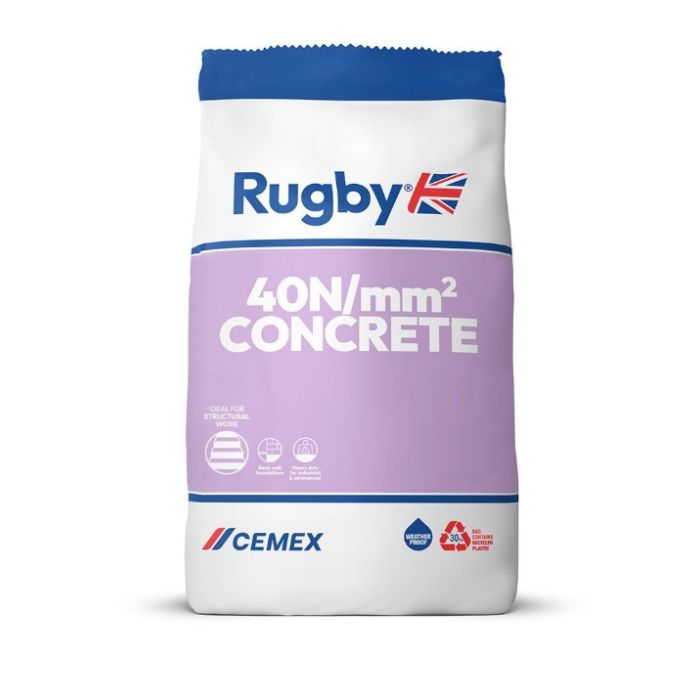
Rugby General Purpose 40N Concrete 25kg
A high-strength concrete designed to deliver greater durability than General Purpose Concrete, making it ideal for industrial and commercial applications.
£9.96
Inc VAT
£8.30
Ex VAT
Ex VAT:
Secure Online Payments
Description
A high-strength concrete designed to deliver greater durability than General Purpose Concrete, making it ideal for industrial and commercial applications. It achieves a minimum 28-day strength of 40N/mm² (MPa) at the recommended workability.
Coverage Guide
Thickness: 25mm, Approx. Coverage per 25kg bag: 0.46m²
Thickness: 50mm, Approx. Coverage per 25kg bag: 0.23m²
Thickness: 75mm, Approx. Coverage per 25kg bag: 0.15m²
Thickness: 100mm, Approx. Coverage per 25kg bag: 0.115m²
Minimum thickness recommended for concrete pathways is 75mm.
For driveways with a firm subsoil a minimum thickness of 100mm is recommended.
Health & Safety
Wet concrete: Avoid skin and eye contact. The risks of dermatitis and burns are increased if the material is allowed to continue rubbing against the skin (e.g. inside boots, in gloves or through saturated clothing). Do not kneel or sit on the wet materials without the correct personal protective clothing.
Concrete dust: The creation of dust from the cutting or surface treatment of hardened concrete should be kept to a minimum, with work methods and engineering control measures being used to reduce exposure. It is also strongly advised to use respiratory protective equipment in such circumstances.
Bagged dry-mix concrete: When handling bags take care when lifting. Due regard should be paid to the risks outlined in the Manual Handling Operations Regulations 1992. Some bags may have a small amount of cement on the outer surface. Appropriate personal protective clothing should therefore be used whilst handling.
Personal Protective Equipment
Respiratory Protection: Suitable respiratory protection (HSE approved standard) should be worn.
Hand and Skin Protection: Protective clothing should be worn which ensures that concrete does not come into contact with the skin. Wear waterproof gloves, waterproof trousers and boots, also knee pads if kneeling down to finish a surface. Should wet concrete, mortar or screed get inside boots, gloves or other protective clothing then this protective clothing should be immediately removed and the skin thoroughly washed as well as the protective clothing/footwear.
Eye Protection: Dust-proof goggles (HSE approved standard) should be worn whenever there is a risk of cement powder or any cement/water mixture entering the eye. Suitable protection is advisable where there is a risk of material splashing.
Downloads